

How Field Research Turned an Ignored Product into a $13M Strategic Pivot :
Transforming Clinical Trial Recruitment
Company
Viz.ai
Solutions
Assessment and Redesign
Strategy Partner
Timeline
6 weeks
Challenge
Research coordinators were drowning in manual work and the product built to help them was being ignored.
Viz.ai's clinical trial recruitment tool, Viz Recruit, was functional but unloved. While the company's stroke detection algorithms were thriving, Recruit sat on the sidelines with low engagement.
When a sponsor infused funding to innovate the product, leadership faced a critical question: What would it take to make this product worth the investment?
The pressure was on. Research coordinators at hospital sites were struggling with scattered data, manual chart reviews, and the physical burden of attending patient appointments just to capture protocol-compliant data. Most importantly, without understanding the full clinical trial workflow, the product team couldn't see where Recruit fit or where it was failing. Here’s where the Truth Layer approach changed that.
APPROACH
Timeline:
6 weeks
Role:
Lead UX Researcher (in-house at Viz.ai)
methods:
Participatory design workshops, journey mapping
Phase 1: Training a Cross-Functional Team (Week 1-2)
Even as a solo researcher, I never work alone. Stakeholders are my key collaborators. The Product Manager and Business Development Analyst had never conducted structured research, so I trained them to co-facilitate. This ensured that what we learned could be rapidly incorporated into strategy and ideas could be tested in real-time.
Phase 2: Designing for Real-World Constraints (Week 2-3)
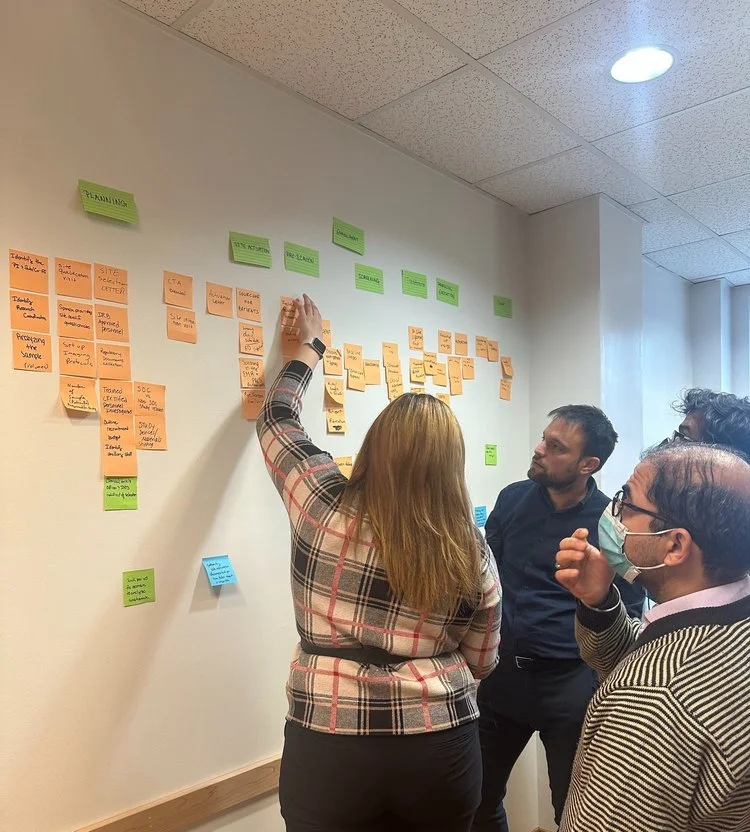
Clinical schedules are tough to coordinate, so I structured the workshops to accommodate drop-in participation. Whether a participant had 5 minutes or 30 minutes, they could contribute to the evolving journey map, building on what came before. Truth Layer’s research can work with your industry’s constraints and still extract value.
We ran workshops at two sites chosen to represent opposite ends of the spectrum:
Site A: Well-resourced academic hospital with robust research funding
Site B: Community hospital with limited resources
This contrast was critical. We needed to see how the workflow changed across different environments.
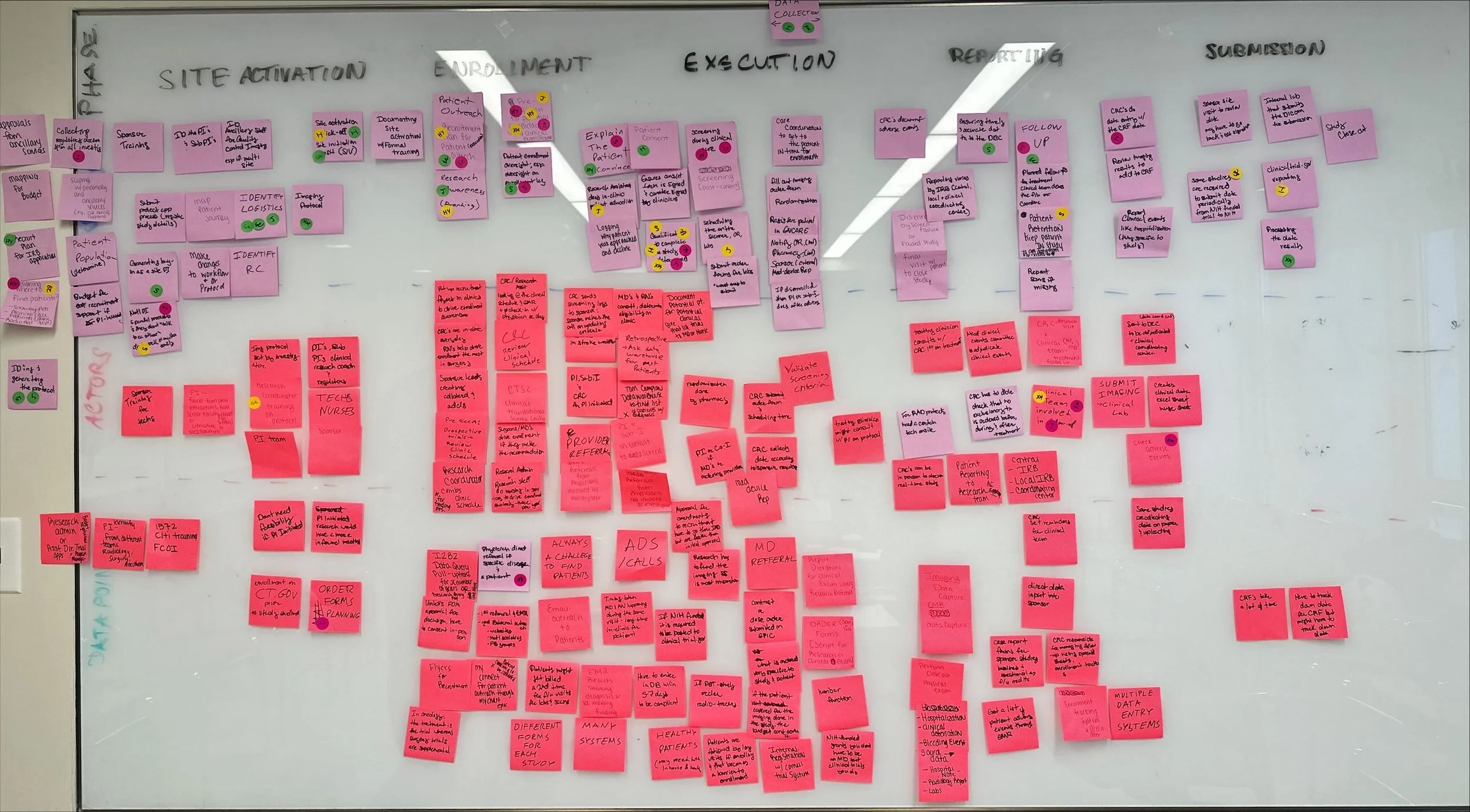
Phase 3: Journey Mapping & Dot Voting (Week 4-5)
16 clinicians and research coordinators mapped their end-to-end clinical trial workflow across all three phases: Planning, Enrollment, and Reporting. We layered backstage processes and system touchpoints onto their journeys, then had participants vote on the most critical pain points using initialed colored dots.
By Day 2, something shifted. My PM partner, who'd sat quietly in the back on Day 1, was standing at the board, confidently leading the discussion. He understood the problems and could engage the participants on the solution.
insights
The product was laser-focused on adding value to enrollment, but the real was further down the workflow. Research coordinators were drowning in manual data entry.
Clinical trial recruitment teams were spending hours transcribing patient data.
Research coordinators had to do extra legwork to ensure accurate transcription to track patient progress.
The process was error-prone and time-consuming.
The strategy:
Viz Recruit had the opportunity to automate the most inefficient aspect of clinical trial recruitment through EHR integration.
Investment in integration architecture was the throughline that would automate data capture and help clinical trial teams track participant progress more efficiently.
IMPACT
100% of recommendations made the product roadmap because the PM was a research partner, cutting down delivery time.
Investment in one product drove ROI for multiple products; Recruit became the catalyst for the company to invest in EHR integration capabilities across its product suite
An estimated $13M ARR generated; Viz Recruit went from "unloved child" to proof of concept for Viz's expanded subscription model. The research insights enabled the company to invest their resources where they would have the most positive impact.
is your team struggling with workflow inefficiencies?
Truth Layer's Assessment & Redesign service delivers field interviews, service blueprints, pain-point analysis, and actionable pilot plans in 4-6 weeks.